
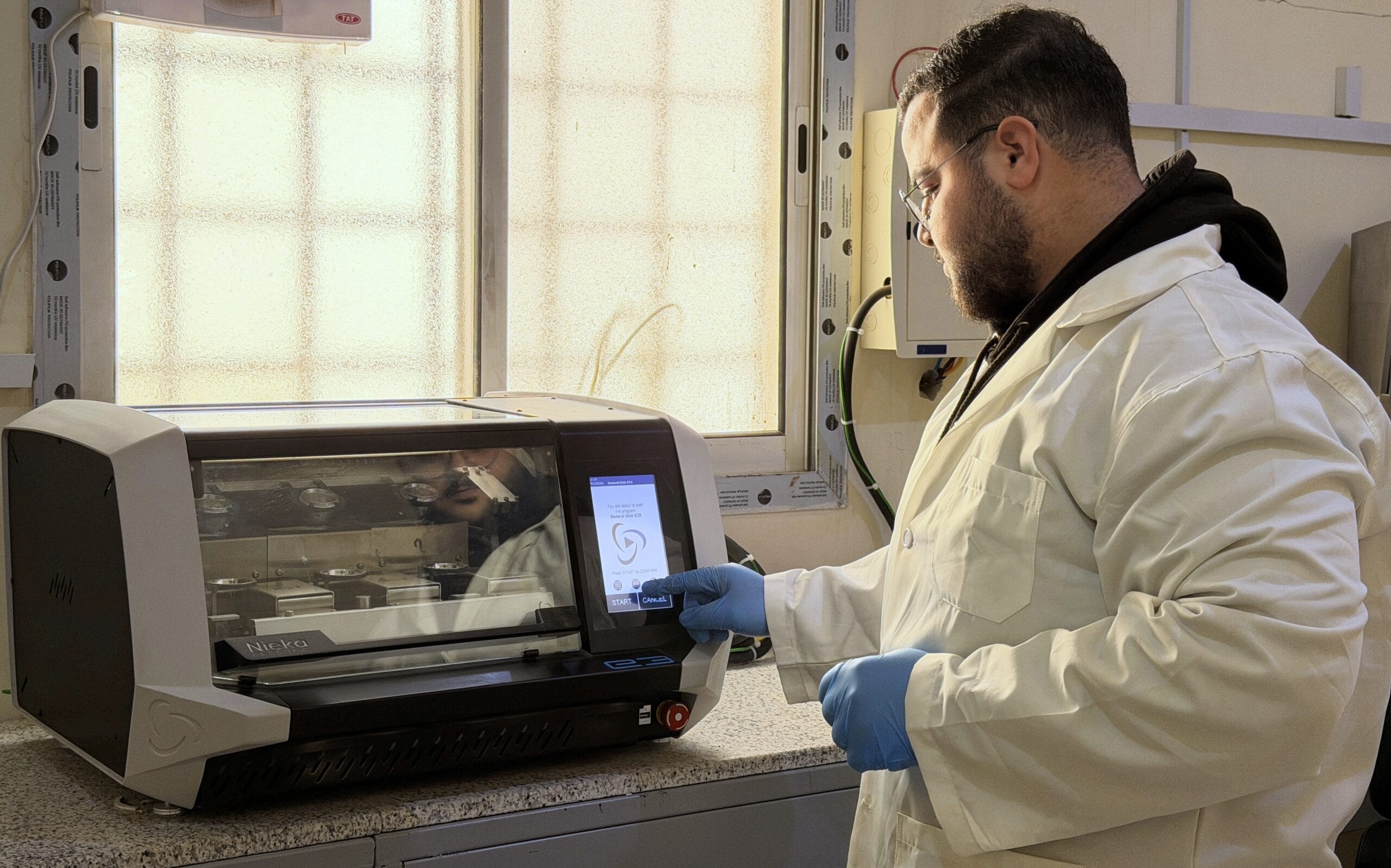
Geochemical Analyses
Our Geochemical Analysis laboratory delivers comprehensive, high-quality elemental characterization for geological and environmental samples, supporting mineral exploration, resource evaluation, and research applications. Using advanced preparation techniques and instrumentation (including ICP-OES, ICP-MS, and XRF), we provide accurate determination of major, minor, and trace elements across a wide range of matrices such as rocks, soils, sediments, and mineralized materials. Our capabilities include partial to near-total and total digestion approaches, precious metal determination, ultra-trace exploration techniques, and specialized fusion methods to ensure reliable quantification even in refractory or complex mineral systems
Elemental analysis by ICP-MS and ICP-OES

Four Acid Digestion 4AD
Four-acid digestion is the most vigorous digestion in geochemistry analysis. This method uses a sequential combination of nitric, perchloric, and hydrofluoric acids, followed by a final dissolution with hydrochloric acid, resulting in near-total sample decomposition. The process effectively liberates most major and trace elements for multi-element geochemical analysis.
Four Acid Digestion 4AD
Four-acid digestion is the most vigorous digestion in geochemistry analysis. This method uses a sequential combination of nitric, perchloric, and hydrofluoric acids, followed by a final dissolution with hydrochloric acid, resulting in near-total sample decomposition. The process effectively liberates most major and trace elements for multi-element geochemical analysis.
Borate Fusion/ICP
Borate fusion digestion is particularly effective for refractory minerals (such as zircon, sphene, monazite, chromite, and gahnite), rare earth elements (REEs), and other high field strength elements. It is commonly applied when complete elemental recovery is required for lithogeochemistry, resource evaluation, or major oxide analysis. Final analysis is typically performed by ICP-OES and ICP-MS, delivering high-quality data suitable for demanding geochemical applications.

Borate Fusion/ICP
Borate fusion digestion is particularly effective for refractory minerals (such as zircon, sphene, monazite, chromite, and gahnite), rare earth elements (REEs), and other high field strength elements. It is commonly applied when complete elemental recovery is required for lithogeochemistry, resource evaluation, or major oxide analysis. Final analysis is typically performed by ICP-OES and ICP-MS, delivering high-quality data suitable for demanding geochemical applications.

Fire Assay (for precious metals)
There are two types of fire assay, NiS and Pb fire assays In Pb-Fire assay PGEs are extracted from the sample matrix by reductive fusion at 1100 °C and collected in a lead capsule. The lead capsule is then placed in a preheated cupel vessel where, when heated to 950°C, the lead oxidizes to recover silver, gold, platinum, and palladium in bead form. The Ag bead is digested in a hot HNO3 + HCl solution (95°C). The sample solution is then analyzed for Au, Pt, and Pd by ICP-MS.
Fire Assay (for precious metals)
There are two types of fire assay, NiS and Pb fire assays In Pb-Fire assay PGEs are extracted from the sample matrix by reductive fusion at 1100 °C and collected in a lead capsule. The lead capsule is then placed in a preheated cupel vessel where, when heated to 950°C, the lead oxidizes to recover silver, gold, platinum, and palladium in bead form. The Ag bead is digested in a hot HNO3 + HCl solution (95°C). The sample solution is then analyzed for Au, Pt, and Pd by ICP-MS.
Sodium Peroxide Fusion
This method which uses Na₂O₂, a strongly oxidizing flux, is particularly effective for samples with high sulphide content, carbonaceous material, or reduced mineral phases, enabling improved recovery of redox elements such as Cr, V, Mn, and Mo. It is ideal for critical minerals and pegmatites, where the base metals (Ni, Zn, Pb, Cu, Ti, Cr, As, Ta, Nb, Mo) as well as other elements such as (Li, K, P, F, B, Be, Cs, W, Rb, Sn, U, Hf, Zr, Th, Y, Mn) are present. It is effective for the analysis of sulfides (> 4%) and refractory minerals.

Sodium Peroxide Fusion
This method which uses Na₂O₂, a strongly oxidizing flux, is particularly effective for samples with high sulphide content, carbonaceous material, or reduced mineral phases, enabling improved recovery of redox elements such as Cr, V, Mn, and Mo. It is ideal for critical minerals and pegmatites, where the base metals (Ni, Zn, Pb, Cu, Ti, Cr, As, Ta, Nb, Mo) as well as other elements such as (Li, K, P, F, B, Be, Cs, W, Rb, Sn, U, Hf, Zr, Th, Y, Mn) are present. It is effective for the analysis of sulfides (> 4%) and refractory minerals.

Aqua Regia Digestion
Aqua regia is a mixture of 1:3 HNO3 to HCl which has significantly greater oxidizing and dissolving properties than HNO3 alone. It is primarily used to dissolve metal sulphides, most sulphates, carbonates, phosphates, organically bound metals, PGE (Au, Pt, Pd), tellurides, selenides and arsenides. Some silicates and alumino-silicate minerals are partially attacked but most remain undissolved so do not form part of the reported results.
Aqua Regia Digestion
Aqua regia is a mixture of 1:3 HNO3 to HCl which has significantly greater oxidizing and dissolving properties than HNO3 alone. It is primarily used to dissolve metal sulphides, most sulphates, carbonates, phosphates, organically bound metals, PGE (Au, Pt, Pd), tellurides, selenides and arsenides. Some silicates and alumino-silicate minerals are partially attacked but most remain undissolved so do not form part of the reported results.
Bulk Leach Extractable Gold (BLEG) Method
It is a geochemical exploration technique designed to detect extremely low levels of gold. The method relies on cyanide leaching to dissolve gold from a large sample into 0.1% to 0.25% NaCN solution, which turns the solid gold into a liquid Aurocyanide complex, [Au(CN)2]–. Using large sample weights and solvent extraction allows for low detection limits, down to 0.1 ppb. The extract is analyzed for gold, copper, and silver.

Bulk Leach Extractable Gold (BLEG) Method
It is a geochemical exploration technique designed to detect extremely low levels of gold. The method relies on cyanide leaching to dissolve gold from a large sample into 0.1% to 0.25% NaCN solution, which turns the solid gold into a liquid Aurocyanide complex, [Au(CN)2]–. Using large sample weights and solvent extraction allows for low detection limits, down to 0.1 ppb. The extract is analyzed for gold, copper, and silver.
Mobile Ions Leaching
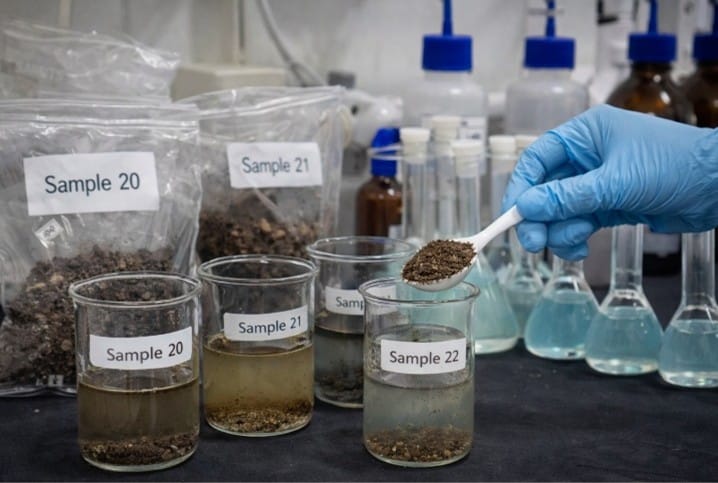
The method targets ions that are adsorbed onto grain coatings, clay surfaces, oxides, or secondary minerals, rather than those locked within primary mineral structures. The method. The method is commonly used in generative or early-stage exploration, where the objective is anomaly detection and target generation rather than total concentration measurement.
Mobile Ions Leaching
The method targets ions that are adsorbed onto grain coatings, clay surfaces, oxides, or secondary minerals, rather than those locked within primary mineral structures. The method. The method is commonly used in generative or early-stage exploration, where the objective is anomaly detection and target generation rather than total concentration measurement.
Elemental analysis by WDXRF
Borate Fusion/XRF
A technique used to produce homogeneous glass discs for the accurate determination of major and minor elements in geological materials using a combination of lithium metaborate and lithium tetraborate with lithium bromide as a fluxing agent. Borate fusion is particularly effective for dissolving silicate, oxide, and refractory minerals, ensuring that elements such as Si, Al, Fe, Ca, Mg, Na, K, Ti, Mn, and P are fully incorporated into the glass matrix.

Borate Fusion/XRF
A technique used to produce homogeneous glass discs for the accurate determination of major and minor elements in geological materials using a combination of lithium metaborate and lithium tetraborate with lithium bromide as a fluxing agent. Borate fusion is particularly effective for dissolving silicate, oxide, and refractory minerals, ensuring that elements such as Si, Al, Fe, Ca, Mg, Na, K, Ti, Mn, and P are fully incorporated into the glass matrix.

Pressed pellets/XRF
A representative sample is taken and finely ground to a fineness of 75 microns. It is then mixed with a binder/grinding aid in a grinding or mixing vessel. The mixture is poured into a compression mold and compressed by a hydraulic press at a pressure of 15–35 tons to form smooth, cohesive discs ready for analysis. These discs are measured using a wavelength-dispersive X-ray spectrometer (WDXRF).
Pressed pellets/XRF
A representative sample is taken and finely ground to a fineness of 75 microns. It is then mixed with a binder/grinding aid in a grinding or mixing vessel. The mixture is poured into a compression mold and compressed by a hydraulic press at a pressure of 15–35 tons to form smooth, cohesive discs ready for analysis. These discs are measured using a wavelength-dispersive X-ray spectrometer (WDXRF).