

Environmental Monitoring
Ambient Air Monitoring
Ambient air monitoring is a critical component of environmental protection, public health assessment, and regulatory compliance. The laboratory provides comprehensive ambient air monitoring services designed to evaluate air quality, identify pollution sources, assess compliance with environmental standards, and support industrial and urban air management programs.
Particulate Matter Monitoring
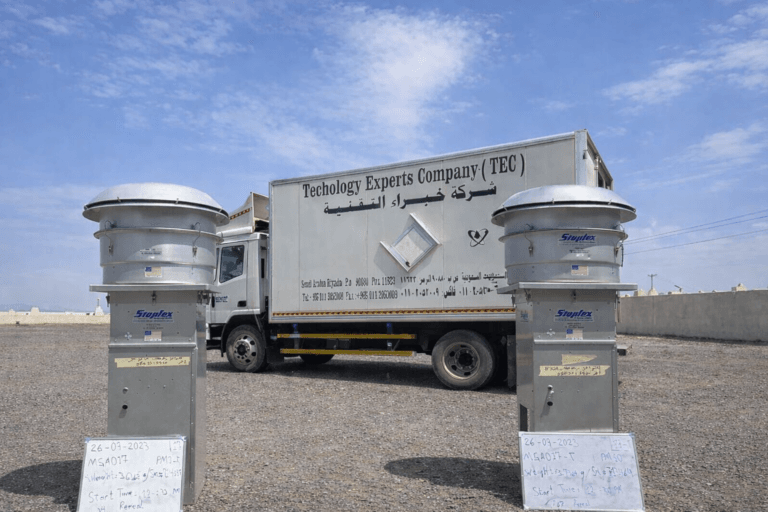
Suspended particulate matter, including PM₂.₅, PM₁₀, and Total Suspended Particulates (TSP), is a primary target in ambient air monitoring due to its health impacts and role as a carrier of metals and organic contaminants. The laboratory utilizes high-volume samplers (HVS) to collect representative air samples over extended periods.
Collected particulate samples can be further analyzed for metals, anions, cations, radionuclides, volatile and semi-volatile organic compounds, providing comprehensive insight into pollution sources and potential health risks.
Particulate Matter Monitoring
Suspended particulate matter, including PM₂.₅, PM₁₀, and Total Suspended Particulates (TSP), is a primary target in ambient air monitoring due to its health impacts and role as a carrier of metals and organic contaminants. The laboratory utilizes high-volume samplers (HVS) to collect representative air samples over extended periods.
Collected particulate samples can be further analyzed for metals, anions, cations, radionuclides, volatile and semi-volatile organic compounds, providing comprehensive insight into pollution sources and potential health risks.
Organic Air Pollutants
Organic air pollutants, including VOCs, SVOCs, BTEX, PAHs, pesticides, and industrial chemicals, are collected using adsorbent tubes or canisters and analyzed with GC-MS/MS, GC-FID, GC-ECD, or LC-MS/MS, depending on the chemical properties of the analytes. These compounds are monitored due to their toxicity, persistence, and potential carcinogenic effects.
Canister-based ambient air sampling is the gold standard for volatile organic compounds (VOCs). This method utilizes internally passivated, evacuated stainless steel containers—often called Suma canisters—to draw in air at a controlled rate using a flow controller. Unlike adsorbent tubes, canisters perform “whole-air sampling,” preserving the sample in its gaseous state without chemical breakthrough.

Organic Air Pollutants
Organic air pollutants, including VOCs, SVOCs, BTEX, PAHs, pesticides, and industrial chemicals, are collected using adsorbent tubes or canisters and analyzed with GC-MS/MS, GC-FID, GC-ECD, or LC-MS/MS, depending on the chemical properties of the analytes. These compounds are monitored due to their toxicity, persistence, and potential carcinogenic effects.
Canister-based ambient air sampling is the gold standard for volatile organic compounds (VOCs). This method utilizes internally passivated, evacuated stainless steel containers—often called Suma canisters—to draw in air at a controlled rate using a flow controller. Unlike adsorbent tubes, canisters perform “whole-air sampling,” preserving the sample in its gaseous state without chemical breakthrough.
Gaseous Pollutant Monitoring
The laboratory monitors gaseous pollutants such as nitrogen oxides (NOx), sulfur dioxide (SO₂), carbon monoxide (CO), ozone (O₃), and other industrial emissions. Specialized sampling methods, including continuous monitoring, passive samplers, and sorbent-based collection, are employed to provide accurate concentration data. These measurements support the evaluation of combustion processes, industrial emissions, and atmospheric chemical interactions.
Meteorological Parameters
Air quality data are interpreted in conjunction with meteorological parameters such as wind speed, wind direction, temperature, humidity, and atmospheric pressure. These parameters are essential for interpreting pollutant dispersion, transport, and seasonal variability, enabling accurate environmental assessment and modeling.
Stack Emissions Monitoring
Stack emission monitoring is a critical component of environmental management for industrial facilities, power plants, cement factories, refineries, and other industrial operations. Isokinetic sampling ensures that the velocity of air entering the sampling probe matches the velocity of the stack gas, allowing the particulate matter collected to be representative of actual stack emissions.
Particulate Matter Sampling and Analysis
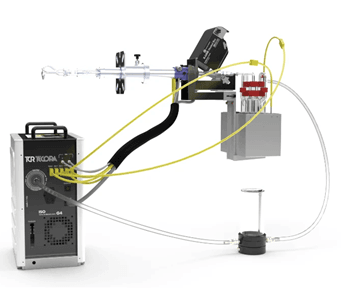
Using isokinetic sampling, the laboratory can accurately measure Total Suspended Particulates (TSP), PM10, and other size-fractionated particulates. Collected particulate samples can be further analyzed for metals, trace elements, radionuclides, and associated chemical pollutants, providing comprehensive characterization of stack emissions.
Particulate Matter Sampling and Analysis
Using isokinetic sampling, the laboratory can accurately measure Total Suspended Particulates (TSP), PM10, and other size-fractionated particulates. Collected particulate samples can be further analyzed for metals, trace elements, radionuclides, and associated chemical pollutants, providing comprehensive characterization of stack emissions.
Gaseous Pollutant Monitoring
Stack monitoring also includes combustion-related gases and acid gases, such as Sulfur dioxide (SO₂), Nitrogen oxides (NOx), Carbon monoxide (CO), Hydrogen chloride (HCl) and hydrogen fluoride (HF), Volatile organic compounds (VOCs) and semi-volatile organic compounds (SVOCs)
USEPA Standard Methods
The laboratory adheres to established USEPA stack sampling methods for accuracy and regulatory compliance:
EPA Method 5: Determination of particulate matter from stationary sources using isokinetic sampling and gravimetric analysis. This method is widely used for TSP and PM mass measurements in flue gases.
EPA Method 23: Measurement of visible emissions (opacity) from stationary sources, often used alongside particulate collection to assess compliance with visible emissions standards.
EPA Method 26A: Measurement of acid gases such as hydrogen chloride (HCl) and hydrogen fluoride (HF) in stack emissions. It involves isokinetic sampling with impingers containing a chemical absorbing solution, followed by laboratory analysis to quantify acid gas concentrations.
EPA Method 29: Determination of metals emissions, including arsenic, beryllium, cadmium, chromium, lead, manganese, mercury, nickel, and others, from stationary sources using isokinetic particulate collection followed by laboratory analysis.
EPA Method 0010: Measurement of stack gas velocity and volumetric flow rates, critical for calculating mass emissions and ensuring isokinetic sampling conditions.